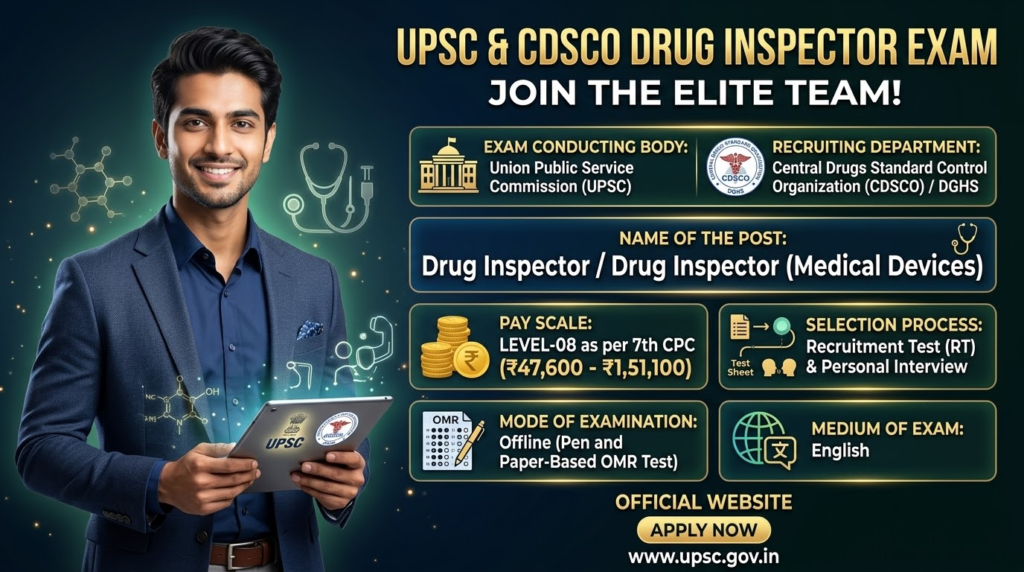
UPSC Drug Inspector Exam Syllabus 2026 – Are you an aspiring pharmacy, medical, or engineering graduate looking to secure a highly prestigious Central Government job? The Union Public Service Commission (UPSC), in collaboration with the Central Drugs Standard Control Organization (CDSCO), has officially commenced the recruitment process for the post of Central Drug Inspector for the 2025-2026 cycle.
The role of a Central Drug Inspector is highly respected and carries immense responsibility. These officers are tasked with enforcing the Drugs and Cosmetics Act of 1940, conducting rigorous inspections of pharmaceutical manufacturing units, ensuring Good Manufacturing Practices (GMP) and Good Laboratory Practices (GLP) compliance, and ultimately safeguarding the health of the nation by monitoring drug and medical device safety.
Given the high-profile nature of this Grade-B Gazetted Officer post, the competition is notoriously tough. To beat the competition, candidates need a foolproof preparation strategy, which strictly begins with a thorough understanding of the official UPSC Drug Inspector Syllabus 2025. The syllabus has been carefully curated to test a candidate’s core technical knowledge in Pharmaceutical Sciences, Biomedical concepts, Drug Regulatory Laws, and General Awareness.
In this comprehensive, SEO-optimized article on Govt Selection, we have provided a detailed “box-wise” breakdown of the UPSC Drug Inspector Syllabus, the latest exam pattern, the best preparation books, and a direct link to download the official Syllabus PDF.
UPSC Drug Inspector Exam Syllabus 2026
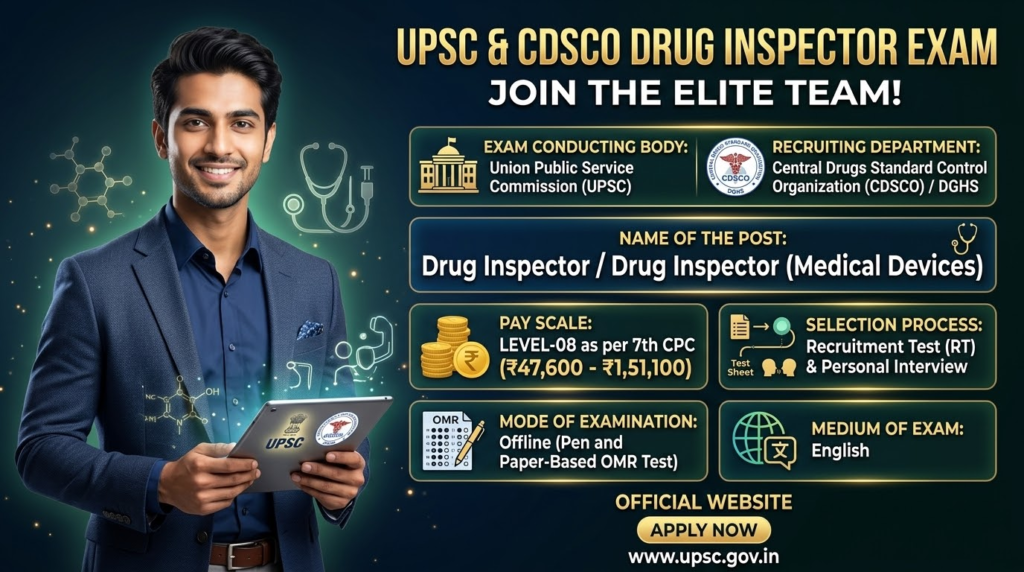
UPSC Drug Inspector Recruitment 2026- Quick Overview – UPSC Drug Inspector Exam Syllabus 2026
Before diving deep into the syllabus and technical topics, let us take a quick look at the fundamental highlights of the UPSC Drug Inspector Examination 2025.
| Exam Feature | Important Details |
| Exam Conducting Body | Union Public Service Commission (UPSC) |
| Recruiting Department | Central Drugs Standard Control Organization (CDSCO) / DGHS |
| Name of the Post | Drug Inspector / Drug Inspector (Medical Devices) |
| Pay Scale | Level-08 as per 7th CPC (₹47,600 – ₹1,51,100) |
| Selection Process | Recruitment Test (RT) & Personal Interview |
| Mode of Examination | Offline (Pen and Paper-Based OMR Test) |
| Medium of Exam | English |
| Official Website | www.upsc.gov.in |
Latest UPSC Drug Inspector Exam Pattern 2026 – UPSC Drug Inspector Exam Syllabus 2026
Understanding the exam pattern is the key to managing your time and maximizing your score. The UPSC conducts a Recruitment Test (RT) followed by an Interview. The written examination evaluates your technical pharmacy knowledge along with general awareness.
| Subject / Section Name | Question Type | Maximum Marks | Total Time Duration |
| Paper-I: Pharmacy & Allied Sciences (Core Technical Subjects, Regulatory Laws, Medical Devices) | Objective Multiple Choice Questions (MCQs) | 200 Marks | 2 Hours (120 Minutes) |
| Paper-II: General Knowledge (Current Affairs, English, Reasoning, General Science) | Objective Multiple Choice Questions (MCQs) | 50 Marks | 1 Hour (60 Minutes) |
| Personal Interview | Face-to-Face Viva Voce | Varies (Usually 100 Marks) | Not Applicable |
(Important Note: There is a strict negative marking penalty in the UPSC Drug Inspector examination. For every incorrect answer marked by the candidate, One-Third (1/3rd) of the marks assigned to that question will be deducted. Unattempted questions will not attract any penalty).
Detailed UPSC Drug Inspector Core Syllabus 2026 (Technical Subjects) – UPSC Drug Inspector Exam Syllabus 2026
The core technical syllabus carries the highest weightage in the examination. Candidates must have an absolute grasp over graduation-level Pharmaceutical Sciences, Biomedical Engineering concepts, and Regulatory Laws. Below is the detailed box-wise list of the technical topics:
| S.No. | Subject / Chapter | Detailed Concepts Covered |
| 1 | Drug Laws & Regulatory Affairs | Drugs and Cosmetics Act 1940 & Rules 1945; Medical Devices Rules 2017; Pharmacy Act 1948; Narcotic Drugs & Psychotropic Substances Act; DPCO 1995; Magic Remedies Act; CDSCO Guidelines; ICH Guidelines. |
| 2 | Pharmaceutics & Manufacturing | Tablet and Capsule coating; Parenteral Preparation and Quality Control; Blood Fluids and Electrolytes; Emulsions, Suspensions, Ointments; Surgical Dressings; Good Manufacturing Practices (GMP); Good Laboratory Practices (GLP). |
| 3 | Pharmacology & Toxicology | Drug-Receptor Interactions; ADME Profile (Absorption, Distribution, Metabolism, Excretion); Bioavailability; Adverse Drug Reactions; Toxicity; Routes of Administration; Drug Antagonists; Pharmacokinetics. |
| 4 | Pharmaceutical Analysis | Limit Tests; Bio-Assays; Sterility and Pyrogen Tests; Spectrophotometry (UV, IR, NMR); Titrimetry; Kerl Fischer Titration; Microbiological Assay of Vitamins and Antibiotics. |
| 5 | Pharmaceutical & Medicinal Chemistry | Chemistry of drugs; Structure-Activity Relationships (SAR); Organic and Inorganic Chemistry; Steroids; Antihistaminic Agents; Sedatives and Hypnotics; Analgesics; Cardiovascular Agents. |
| 6 | Pharmacognosy | Source, uses, and adulteration of natural drugs; Chemical constituents of Rauwolfia, Cinchona, Belladonna, Senna, Aloe, Opium, Digitalis, Tulsi, Bael, and Ephedra. |
| 7 | Microbiology & Biotechnology | Sterilization Techniques; Microbial Contamination; Immunology & Vaccines; Animal Cell Culture; Recombinant DNA Technology; Proteomics. |
| 8 | Hospital & Clinical Pharmacy | Handling of Prescriptions; Drug Incompatibilities; Storage Conditions of Drugs; Clinical Trials (Schedule Y); Good Clinical Practices (GCP). |
| 9 | Anatomy, Physiology & Health Education | Digestive System, Reproductive System, Urinary System, Blood, Eye, Ear, Respiratory System; Basic First Aid; Nutrition; Population Control. |
UPSC Drug Inspector General Knowledge & Aptitude Syllabus
Apart from the technical domain, candidates must also clear Paper-II, which tests their awareness of current events and basic aptitude.
| Subject Area | Key Topics Included |
| General Knowledge & Current Affairs | Current issues of National and International importance; Important Financial & Economic News; Science – Inventions & Discoveries; Indian Constitution; Geography; General Politics; Budget and Five-Year Plans. |
| English Language Proficiency | Basic English Grammar; Vocabulary; Reading Comprehension; Synonyms & Antonyms; Sentence Correction. |
| Aptitude & Reasoning | Basic Quantitative Aptitude; Logical Reasoning; Data Interpretation; Analytical Thinking. |
| Computer Applications | Basic knowledge of MS Office; Internet handling; Data Management; Basics of Computer Hardware and Software. |
How to Download the UPSC Drug Inspector Syllabus 2026 PDF?
Downloading the official syllabus PDF directly to your device is highly recommended. It allows you to track your daily progress and ensures you do not miss any micro-topics. Follow these simple steps to download the official syllabus:
Step 1: Open your preferred web browser and visit the official Union Public Service Commission website at www.upsc.gov.in.
Step 2: On the homepage dashboard, navigate to the “Examinations” or “Recruitment” tab.
Step 3: Click on the link titled “Advertisement for the post of Drug Inspector / Drugs Inspector (Medical Devices) in CDSCO – 2026”.
Step 4: The complete official notification PDF will open on your screen.
Step 5: Scroll down to the “Scheme and Syllabus of the Recruitment Test (RT)” section.
Step 6: Click the download icon to save the PDF to your smartphone or computer. Take a printout and highlight the specific subjects for easy daily reference.
Best Books for UPSC Drug Inspector Preparation
Having the right study materials is half the battle won. To secure maximum marks in the Recruitment Test, our experts highly recommend the following standard reference books:
| Subject / Topic | Name of the Book & Author |
| Pharmacology | Essentials of Medical Pharmacology by K.D. Tripathi |
| Pharmaceutics | The Theory and Practice of Industrial Pharmacy by Leon Lachman |
| Pharmaceutical Analysis | Instrumental Methods of Chemical Analysis by Gurdeep R. Chatwal |
| Drug Laws & Jurisprudence | Forensic Pharmacy by N.K. Jain / Bare Act of Drugs & Cosmetics Act |
| Pharmacognosy | Pharmacognosy by C.K. Kokate |
| General Knowledge | Lucent’s General Knowledge / Manorama Yearbook 2025 |
Preparation Strategy: How to Crack UPSC Drug Inspector 2026? – UPSC Drug Inspector Exam Syllabus 2026
- Master the Drug Laws: The Drugs and Cosmetics Act of 1940 and Medical Devices Rules 2017 form the absolute core of a Drug Inspector’s daily duties. Spend significant time memorizing all the important Schedules (Schedule M, Y, X, C, etc.).
- Focus on Quality Control & GMP: Ensure you have a deep understanding of Good Manufacturing Practices (GMP) and Quality Assurance/Quality Control (QA/QC) guidelines, as these fetch direct theoretical questions.
- Practice Previous Year Papers (PYQs): The UPSC has a specific pattern of framing multiple-choice questions. Solving the previous 5-10 years’ Drug Inspector papers will give you an exact idea of the difficulty level and the most repeated topics.
- Beware of Negative Marking: Since there is a 1/3rd negative marking penalty, avoid blind guessing. Only attempt questions you are reasonably confident about. Accuracy is more important than attempting all 100 questions.
- Prepare for the Interview Early: Do not wait for the written results to start preparing for the interview. Brush up on your communication skills, current pharmaceutical news, and CDSCO updates, as the interview holds a 25% weightage in final selection.
Frequently Asked Questions (FAQs)
Q1: What is the selection process for the UPSC Drug Inspector exam 2026?
Ans: The selection process primarily consists of an Objective-type Written Examination (Recruitment Test) followed by a Personal Interview (Viva-Voce) and final Document Verification.
Q2: Is there any negative marking in the UPSC Drug Inspector exam?
Ans: Yes, there is a strict negative marking system. One-third (1/3rd) of the marks assigned to a question will be deducted for every incorrect answer.
Q3: Do I need to study Medical Devices Rules for this exam?
Ans: Yes, especially since recent UPSC notifications specifically target “Drugs Inspector (Medical Devices)”, a thorough knowledge of the Medical Devices Rules 2017 and biomedical engineering basics is extremely crucial.
Q4: Can a B.Tech graduate apply for the UPSC Drug Inspector post?
Ans: Yes, as per recent notifications, candidates possessing a B.E./B.Tech degree in Biomedical, Chemical, Biotechnology, or Medical Electronics are eligible to apply, particularly for the Medical Devices division.
Q5: What is the total marks and duration for Paper-I?
Ans: Paper-I (Pharmacy and Allied Sciences) is generally conducted for 200 marks and must be completed within a time duration of 2 Hours (120 minutes).
Q6: In which language will the UPSC Drug Inspector question paper be set?
Ans: The question paper for the Recruitment Test (RT) will be set exclusively in English.
Q7: Which subject carries the highest weightage in the written exam?
Ans: Based on past exam trends, Pharmaceutical Jurisprudence (Drug Laws), Pharmacology, Pharmaceutics (Manufacturing), and Quality Control/Analysis carry the highest weightage in the question paper.
UPSC Drug Inspector Exam Syllabus 2026